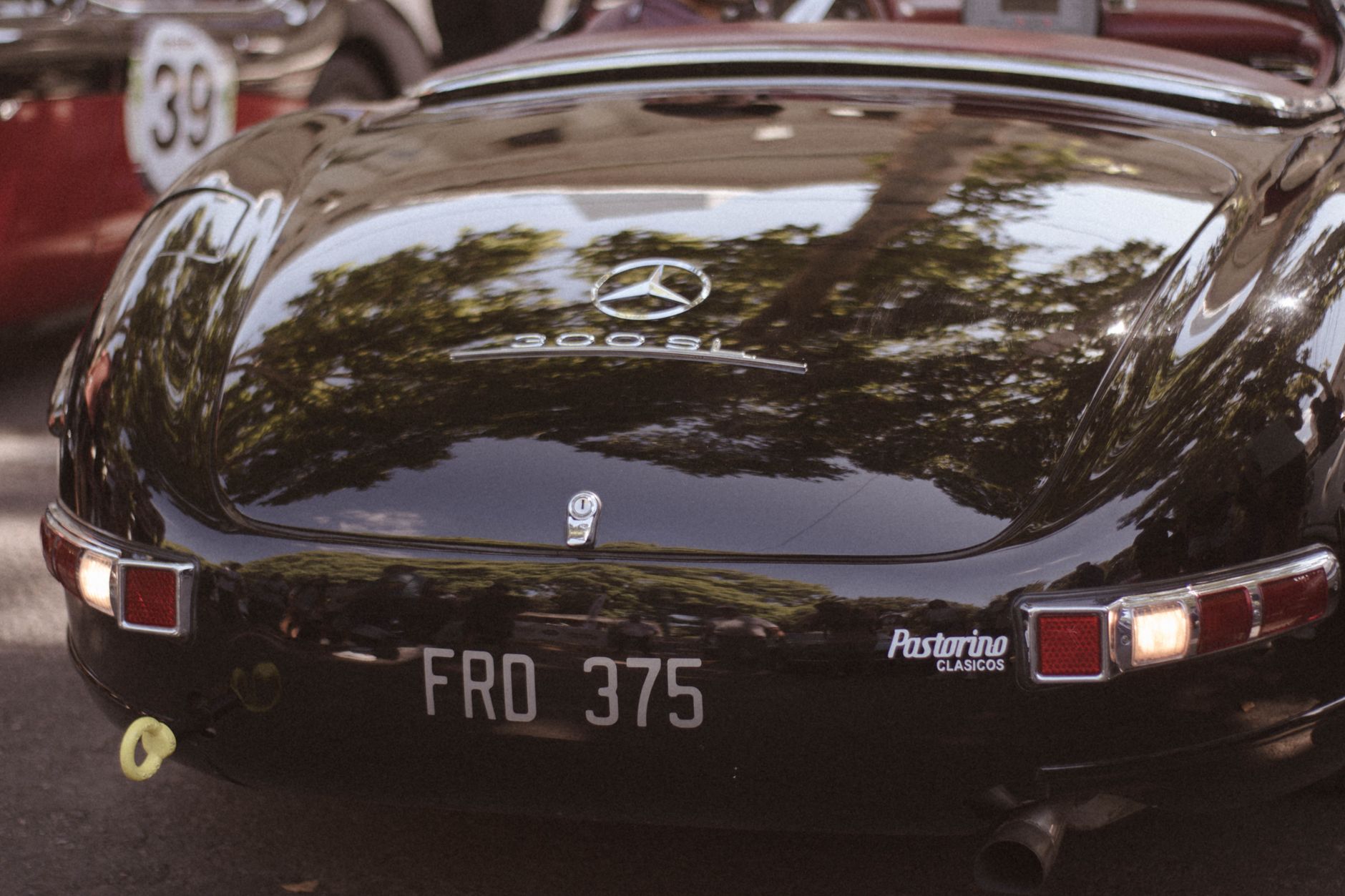
Two Philosophies of the 1950s Grand Tourer
The Mercedes-Benz 300 SL and Ferrari 250 GT emerged from the same decade but opposite design philosophies: Mercedes engineered a singular, racing-derived flagship with one coherent specification, while Ferrari built a continuously evolving family of road and competition cars under one model name. For collectors, this distinction matters more than badge or nationality.
Mercedes-Benz approached the 300 SL as a single engineering problem to be solved once, brilliantly, and then produced in a tightly controlled run. Ferrari approached the 250 GT as a platform, a 2,953cc V12 architecture that Pinin Farina, Scaglietti, and Carrozzeria Boano reshaped repeatedly across six years of competition feedback and client demand. Both strategies produced legends. They did not produce comparable collectibles.
This piece follows the same diligence-first format as the site’s prior Mercedes-Benz 507 vs. 300 SL comparison, because the stakes here are higher. A buyer confusing a standard-production 250 GT with a short-wheelbase alloy competition car isn’t making a rounding error. They’re potentially misjudging value by a factor of ten or more.
| Attribute | Mercedes-Benz 300 SL (W198) | Ferrari 250 GT (family) |
|---|---|---|
| Production era | 1954-1957 | 1954-1964, multiple sub-variants |
| Engine | 3.0L inline-six, fuel injected | 2,953cc Colombo V12, carbureted |
| Claimed power | 215 hp | 220-260+ hp depending on variant |
| Defining engineering | Tubular space frame, gullwing doors | Evolving chassis/wheelbase, coachbuilt bodies |
| Collector distinction | Single, bounded specification | Body, wheelbase, and coachbuilder define value |
| Market implication | Relatively standardized comps | Comps only valid within exact same sub-variant |
The 300 SL: A Clearly Defined Icon
The Mercedes-Benz 300 SL is a bounded collectible: one chassis architecture, one engine family, roughly 1,400 units built over three years, with variation limited mainly to Gullwing coupé versus later roadster. This narrow specification range is exactly what makes it easier to value and diligence than a sprawling model family.
Mercedes-Benz’s own official model history classifies the 300 SL as the 198-series racing sports car, built from 1954 to 1957 (Mercedes-Benz, official model history). The Technik Museum’s exhibit documentation specifies a 3.0-liter inline-six producing 215 hp, a top speed up to 240 km/h depending on final-drive gearing, and total production of approximately 1,400 units across that run (Technik Museum).
What made the 300 SL radical in 1954 wasn’t styling, it was structure. The car’s lightweight tubular space frame was so rigid and so intrusive at the sills that conventional doors wouldn’t clear it, which is the actual engineering reason the gullwing doors exist, not a styling flourish retrofitted after the fact. Mercedes paired that frame with mechanical direct fuel injection, a genuine first for a production road car and a major technical distinction at a time when nearly every competitor still relied on carburetors.
Because the W198’s specification range is so narrow, matching-numbers verification is comparatively straightforward. A buyer isn’t choosing between six wheelbase variants and three coachbuilders. They’re mainly confirming originality of engine, chassis, and major components against Mercedes-Benz factory records. That narrower diligence scope is a meaningful part of why the 300 SL trades as a relatively liquid blue-chip collectible rather than a puzzle that requires a marque specialist to solve.
The 250 GT: Why One Name Covers a Dozen Different Cars
“Ferrari 250 GT” describes a family of distinct cars, not a single specification. Coupé, Boano, Tour de France Berlinetta, SWB, California Spider, and GTO share the 2,953cc Colombo V12 architecture but differ enormously in wheelbase, body material, coachbuilder, and competition history, which drives price differences spanning tens of millions of dollars.
Ferrari’s own official history of the early 250 GT Coupé describes a 2,953cc V12 with claimed output of 220 hp, independent front suspension, and a rigid rear axle (Ferrari, official 250 GT Coupé history). That’s the baseline road car. From there, the model diverges sharply.
The 250 GT Berlinetta “Tour de France,” built from 1956 to 1959, carries Pinin Farina-designed, Scaglietti-built aluminum bodywork and a higher-output 260 hp claimed figure from the same basic V12 (Ferrari, official 250 GT Berlinetta history). The later passo corto, or SWB, shortened the wheelbase from 2,600mm to 2,400mm while retaining the same V12 architecture (Ferrari, official 250 GT Berlinetta passo corto history). That shorter wheelbase transformed handling balance and cemented the SWB’s competition reputation, and it’s a specification detail that separates an eight-figure car from a mid-six-figure one.
The 250 GT Variant Ladder
Coupé (steel body, road-focused, lowest tier) → Boano (small coachbuilder run, transitional styling) → Tour de France Berlinetta (alloy Scaglietti body, competition pedigree) → SWB (shortened 2,400mm chassis, alloy or steel body options, serious competition history) → California Spider (open-top, highly coveted, alloy competition examples command the most) → GTO (homologation special, rarest and most valuable, not a standard 250 GT benchmark).
Each step up this ladder can mean a price multiple several times the step below it, driven by body material, coachbuilder, and documented race history, not by the shared “250 GT” name.
Driving Character and Collector Appeal
The 300 SL drives as an engineering statement, a rigid, fuel-injected six-cylinder GT built to be driven hard on public roads. The Ferrari 250 GT family drives as a competition pedigree expressed through a road car, with the V12’s character and the chassis balance varying meaningfully by wheelbase and body.
Behind the wheel, the 300 SL rewards precision. The space frame’s rigidity and the fuel-injected six’s responsiveness make it feel engineered rather than styled, a car built by people solving a mechanical problem first and a design problem second. Collectors who gravitate toward the 300 SL tend to prize that single-minded coherence: one car, one answer, executed at the highest level Mercedes-Benz could manage in 1954.
The 250 GT’s appeal runs the opposite direction. Its value lies in variety and in bloodline. A Tour de France Berlinetta or SWB carries the DNA of actual competition history, Scaglietti coachwork, and Pinin Farina design language that evolved car to car. Collectors drawn to the 250 GT family are often buying into Ferrari’s racing narrative as much as the hardware, which is precisely why documentation of a specific chassis’s competition history can move the needle on price far more than it would for a 300 SL.
Auction Values: What Recent Sales Actually Show
Recent auction results show the 300 SL trading in a relatively tight band near $1.6 million to $1.9 million, while 250 GT variants span from under $1 million for a Boano coupé to over $38 million for a GTO. These figures are observed transaction prices for specific documented cars, not appraisals transferable to other examples of the same model name.
A 1955 Mercedes-Benz 300 SL Gullwing sold for $1,902,500 at the 2025 Monterey auctions (Hagerty Insider, 2025 Monterey Auction Results report). A 1957 300 SL Gullwing Coupé sold for €1,637,500 at a 2026 Villa d’Este sale (Broad Arrow, reported via StockTitan, 2026). That’s a tight band for a car built across one bounded specification run, which is itself informative: the 300 SL’s narrow variation keeps its comps genuinely comparable.
The 250 GT family tells a different story entirely. A 1956 Ferrari 250 GT Boano Alloy Coupé sold for €911,875 at the same 2026 Villa d’Este sale (Broad Arrow, via StockTitan, 2026), a fraction of a 1961 Ferrari 250 GT SWB Alloy Coupe that sold for $8,090,000 during 2026 Monterey Car Week, an event that generated $756 million in total sales (Hagerty, 2026 Monterey Car Week Auctions report). Move up the ladder further and a 1961 Ferrari 250 GT SWB California Competizione Alloy Spider sold for $25,305,000 at the 2025 Monterey auctions (Hagerty Insider, 2025 Monterey Auction Results report).
Auction Comps at a Glance
1955 300 SL Gullwing: $1,902,500 (Hagerty Insider, 2025 Monterey). 1957 300 SL Gullwing Coupé: €1,637,500 (Broad Arrow/StockTitan, 2026 Villa d’Este). 1956 250 GT Boano Alloy Coupé: €911,875 (Broad Arrow/StockTitan, 2026). 1961 250 GT SWB Alloy Coupe: $8,090,000 (Hagerty, 2026 Monterey Car Week). 1961 250 GT SWB California Spider: $25,305,000 (Hagerty Insider, 2025 Monterey). 1962 250 GTO: $38,500,000 (Hagerty Insider, 2026 January Auctions review).
These are individual transaction results tied to specific chassis, not standing appraisals. The GTO figure in particular reflects a rarer, later homologation model and should never be used as a benchmark for a standard 250 GT.
Investment Outlook: Strengths and Risks of Each Model
The 300 SL offers lower diligence complexity and a tighter, more liquid value band, making it the more straightforward blue-chip hold. The 250 GT family offers substantially greater upside at the top of its variant ladder, paired with substantially greater risk of misvaluation if the exact specification isn’t independently verified.
300 SL: Strengths and Risks
The 300 SL’s strength is coherence. With one chassis architecture and a bounded production run, valuation work is comparatively simple: confirm matching numbers, originality, and condition, and the comp set is genuinely comparable car to car. Its risk is the mirror image of that strength: ceiling. Because the specification is fixed, there’s limited room for a single exceptional example to dramatically outperform the field the way a rare alloy SWB can within the 250 GT family.
250 GT: Strengths and Risks
The 250 GT family’s strength is range of outcomes. A documented alloy SWB or California Spider with genuine competition history can appreciate far beyond a standard steel Coupé, and that spread rewards buyers with genuine expertise or access to it. Its risk is the same spread working against an uninformed buyer. Paying SWB-adjacent prices for a car that’s actually a later production example, or missing an undocumented rebody, is a real and expensive failure mode in this market. The 250 GT rewards specialist-level diligence far more than it rewards enthusiasm.
Due Diligence Before You Buy
Buying either car at this price tier requires independent chassis and provenance verification before any transaction, not after. The checklist below applies to both models but matters most for the 250 GT family, where body, coachbuilder, and wheelbase can transform the same nameplate into a radically different asset.
- Verify chassis, engine, and gearbox numbers independently against factory records, rather than relying solely on a seller’s representation.
- Obtain Mercedes-Benz or Ferrari factory documentation, or recognized marque-registry records, confirming original specification and build history.
- Commission a marque-specialist inspection to confirm body material (alloy versus steel) and detect undocumented structural repair or rebody work.
- Request a complete ownership chain and competition history where claimed, since race provenance materially affects 250 GT valuation.
- Cross-reference any claimed auction comp against the exact chassis sold, not just the model name, before using it to justify a price.
- For 250 GT variants specifically, confirm wheelbase measurement and coachbuilder attribution in writing from a recognized authority on the model.
Already own a documented 300 SL or Ferrari 250 GT and want liquidity without selling? Borro works with collectors holding museum-grade classics like these.
Editorial Takeaway
The badge on these cars tells you almost nothing useful about what you’re buying. The exact chassis specification tells you everything. A 300 SL is a 300 SL, with limited variation and a correspondingly disciplined value band. A “250 GT” could be a $900,000 steel Boano coupé or a $25 million alloy competition Spider, and the only way to know which one you’re looking at is to verify the specification yourself, in writing, against factory and registry records.
For HNW buyers and the advisors guiding them, that’s the actual investment question: not German engineering versus Italian coachbuilding, but how much specialist diligence a given acquisition demands before the price can be trusted. Readers comparing broader supercar value trends may also find the site’s prior analysis in McLaren vs. Ferrari: Which Supercar Holds Its Value Better? and The Evolution of Sports Cars: History, Market, and Collector Value useful context for how coachbuilt rarity plays out across other eras.
Frequently Asked Questions
Is the Mercedes-Benz 300 SL a better investment than a Ferrari 250 GT?
Neither is categorically better; they carry different risk-return profiles. The 300 SL offers a narrower, more standardized value band and simpler diligence, while the 250 GT family offers greater upside at the top variants but requires far more specialist verification of exact specification before a price can be trusted.
Why do Ferrari 250 GT prices vary so widely for what seems like the same car?
“250 GT” refers to a family of variants, including Coupé, Boano, Tour de France Berlinetta, SWB, California Spider, and GTO, that share a 2,953cc Colombo V12 architecture but differ in wheelbase, body material, and coachbuilder. These differences, along with documented competition history, drive price differences spanning tens of millions of dollars.
What makes the Mercedes-Benz 300 SL’s gullwing doors necessary rather than stylistic?
The 300 SL’s lightweight tubular space frame extends through the car’s sills at a height that prevents conventional hinged doors from clearing the structure. Mercedes-Benz engineers designed the upward-opening gullwing doors as a solution to this structural constraint, not primarily as a styling choice.
How many Mercedes-Benz 300 SLs were produced?
According to the Technik Museum, approximately 1,400 Mercedes-Benz 300 SL units were produced between 1954 and 1957, encompassing both the Gullwing coupé and later roadster versions, within the 198-series model line as classified by Mercedes-Benz’s official model history.
Is a Ferrari 250 GTO sale price a useful benchmark for a standard 250 GT?
No. The 250 GTO is a rarer, later homologation-special model with a distinct specification and competition purpose. A 1962 example sold for $38,500,000 according to Hagerty Insider’s 2026 January Auctions review, but this figure should not be used to value a standard 250 GT Coupé, Boano, or other earlier variant.
What should a buyer verify before purchasing a 1950s Ferrari or Mercedes-Benz collectible?
Buyers should independently verify chassis, engine, and gearbox numbers against factory or registry records, confirm body material and detect any undocumented structural repairs through a marque-specialist inspection, and obtain complete ownership and competition history documentation before relying on any auction comp as a valuation basis.
Can I borrow against a classic car like a 300 SL or 250 GT instead of selling it?
Specialty lenders, including Borro, offer asset-based loans secured against classic and collector cars for qualifying owners. Terms, eligibility, and valuations vary by individual asset and lender. Borro is not a bank, and interested owners should contact a lender directly for personalized loan terms.
Hold a Documented 300 SL or Ferrari 250 GT?
Borro helps collectors unlock liquidity against museum-grade classics without selling them.
Sources
- Mercedes-Benz, “Mercedes-Benz 300 SL racing sports car (198 series, 1954 to 1957),” official model history
- Technik Museum, “Mercedes-Benz 300 SL Gullwing,” exhibit page
- Ferrari, “Ferrari 250 GT Coupé (1954),” official model history, Ferrari.com
- Ferrari, “Ferrari 250 GT Berlinetta (1956),” official model history, Ferrari.com
- Ferrari, “Ferrari 250 GT Berlinetta passo corto (1959),” official model history, Ferrari.com
- Hagerty Insider, “2025 Monterey Auction Results: Second-Highest Ever Totals, Modern Supercars Lead,” 2025
- Hagerty Insider, “The 2026 January Auctions: By the Numbers,” 2026
- Broad Arrow, reported by StockTitan, “Broad Arrow Celebrates Style and Performance at $40.8M Concorso,” 2026
- Hagerty, “2026 Monterey Car Week Auctions Shatter Record with $756M in Sales,” 2026
This article is for informational purposes only and does not constitute financial advice. Loan terms, eligibility, and asset valuations vary. Contact Borro directly for personalized loan quotes. Borro is not a bank.